
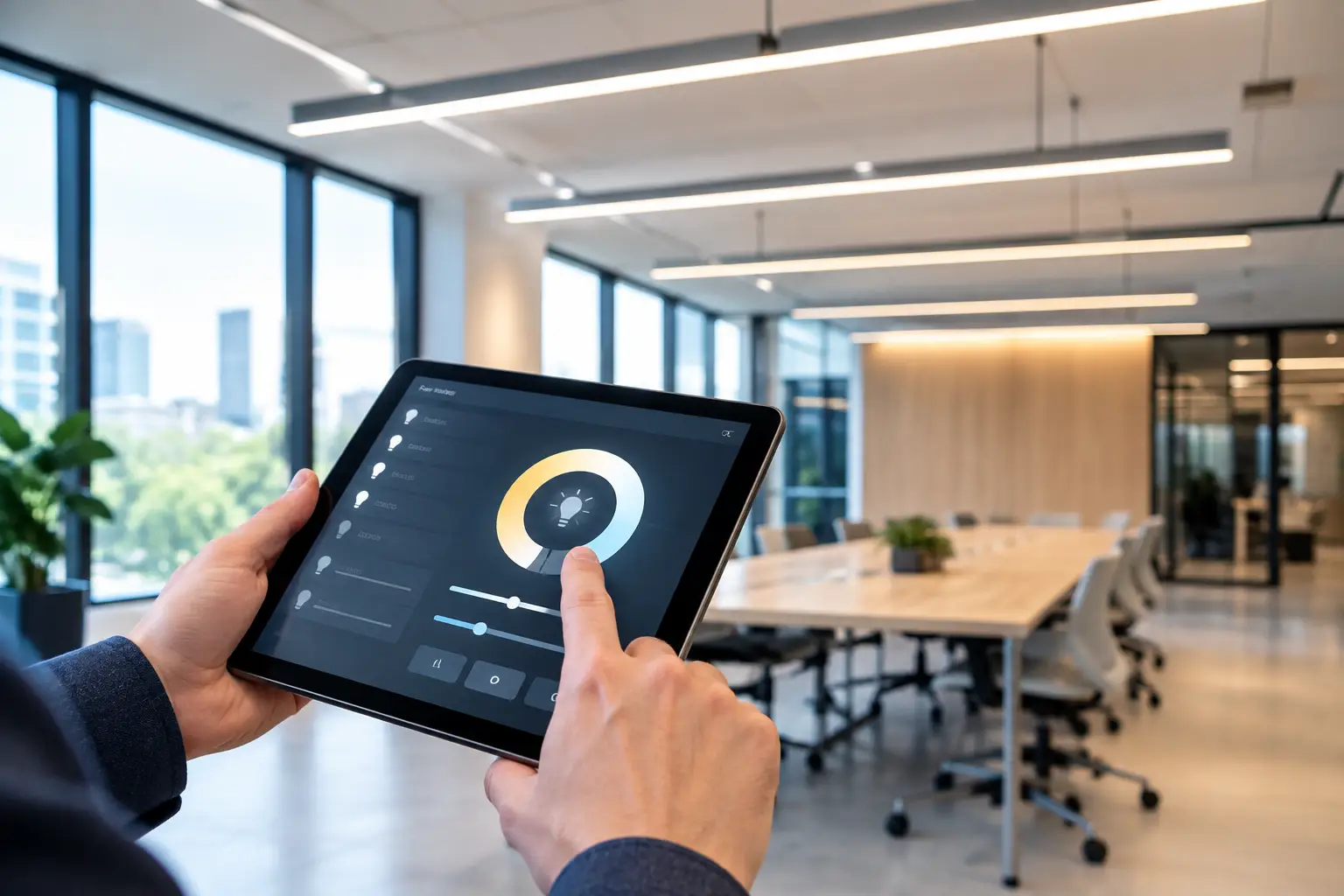
A well-designed lighting scheme should feel effortless: the right light at the right level, in the right place, without banks of switches competing with the interior. DALI lighting systems make that possible by giving each fitting a place within a coordinated, intelligent lighting design. For high-specification homes and commercial buildings, they provide a considered route to better ambience, more useful control and lower unnecessary energy use.
DALI is not simply a dimming method. It is a lighting-control language that allows luminaires, drivers, sensors and control interfaces to communicate. When designed alongside the architecture, electrical installation and wider building technology, it turns lighting from a collection of circuits into a flexible part of the environment.
What are DALI lighting systems?
DALI stands for Digital Addressable Lighting Interface. In a conventional switched installation, one circuit controls every fitting connected to it. If the circuit is on, all of those lights are on. Dimming can add adjustment, but it does not necessarily give each light fitting its own identity.
With DALI, compatible lighting drivers are individually addressable. They can be organised into groups and scenes through software rather than solely through fixed electrical circuit arrangements. A pendant over a dining table, downlights around the room perimeter and concealed joinery lighting can therefore respond differently, even where the client wants them managed from one elegant keypad.
This flexibility is valuable because a building’s use changes. A reception space may need a bright arrival setting in the morning, a calmer setting for evening hospitality and low-level cleaning light after hours. In a family home, the kitchen may serve as a workspace, social space and late-night route through the house. DALI allows the lighting behaviour to reflect those real patterns rather than forcing occupants to manage several separate controls.
Why DALI suits design-led projects
The most successful intelligent lighting is rarely noticed as technology. It supports the proportions of a room, draws attention to materials and artwork, and gives people simple choices that make sense. DALI supports this outcome because the control strategy can be developed around scenes rather than around the limitations of a traditional wiring layout.
A single ‘Evening’ scene might bring the feature pendants to a warm, comfortable level, lower the architectural downlights and illuminate selected shelving. A ‘Welcome’ scene can light key circulation routes, while a ‘Away’ setting can switch off non-essential lighting and retain a measured presence where appropriate. The user sees a small number of clear options. Behind that simplicity is a carefully commissioned system.
For interior designers and architects, the advantage is freedom. Decorative fittings, linear lighting, specialist drivers and architectural luminaires can be brought into one coherent control scheme, provided compatibility is confirmed early. This makes it easier to preserve a clean ceiling plan and reduce visual clutter on the wall.
There is also a practical maintenance benefit. A DALI system can report the status of compatible devices and identify failed lamps or drivers more precisely than a conventional installation. In an office, hotel-style residence or multi-storey development, that visibility can make facilities management more efficient. The level of reporting depends on the equipment and system architecture selected, so it should be agreed as part of the specification rather than assumed.
Control that remains intuitive
Sophisticated control should not require occupants to understand the technology behind it. DALI lighting can be presented through engraved keypads, touch panels, a well-designed app or a wider home automation or BMS interface. The important question is not how many control methods are available, but which ones will be useful every day.
For many homes, a combination of wall keypads and a central interface offers the best balance. Keypads provide immediate, dependable control at the point of use, while the central interface can offer whole-house scenes, scheduling and monitoring. For commercial projects, reception controls, occupancy sensors, daylight response and timed operation may take a more prominent role.
DALI lighting systems and energy performance
Energy efficiency is often discussed as though it begins and ends with LED fittings. LEDs are an essential part of modern lighting design, but control determines whether that efficient source is used intelligently. DALI can reduce waste by allowing lighting to respond to daylight, occupancy, time schedules and programmed scenes.
In a workplace, daylight sensors can lower artificial light near windows while maintaining an appropriate level deeper into the floorplate. Meeting rooms can use occupancy sensing to avoid being lit when vacant. In residential settings, the gains are often less about continual sensor-led control and more about ensuring the house does not remain fully illuminated when only a few areas are in use.
The trade-off is that over-automation can be frustrating. A sensor that turns lights off while someone is sitting quietly reading, or brightens a room abruptly, undermines the experience. Good design considers the purpose of each space, appropriate time delays and manual override. Energy-conscious control should feel helpful, not intrusive.
The decisions that should be made early
DALI is at its best when considered before first fix. Retrofitting is possible in some properties, but it can involve compromises in cabling routes, fitting choice, control locations and access to drivers. Early coordination gives the project team time to establish the lighting intent, select compatible equipment and allocate suitable space for panels, gateways and control hardware.
The quality of light matters as much as the control protocol. Colour temperature, colour rendering, beam angle, glare control and fitting placement should be decided with the interior scheme in mind. A highly capable DALI system cannot compensate for poorly positioned downlights or a decorative fitting that does not deliver enough useful light.
It is equally important to decide which fittings need individual addressing and which can sensibly be grouped. Individual control gives maximum flexibility, but it can add cost and complexity. In a small utility room, simple grouped control may be entirely appropriate. In an open-plan kitchen, living and dining space with several layers of light, granular control is often worth the investment.
Compatibility is a specification issue
Not every LED fitting is DALI-compatible, and products that appear similar can behave differently when dimmed. Drivers must be matched correctly to fittings, and the complete control chain should be assessed rather than selected as isolated components. This is particularly relevant for decorative and bespoke luminaires, where the driver may be concealed within the fitting or supplied separately.
There are also different generations and extensions within the DALI family. DALI-2 has improved interoperability requirements for many control devices, while D4i adds data and power capabilities often relevant to smart luminaire applications. These terms matter to designers and technical teams, but clients need not become protocol specialists. What matters is selecting an approach that meets the desired control, monitoring and future-maintenance requirements without specifying technology for its own sake.
Bringing lighting into a wider building system
DALI becomes especially effective when it forms part of an integrated environment. Lighting scenes can work with automated blinds to manage glare, with climate control to support comfort, and with security settings to create a controlled response when the building is unoccupied. A cinema scene, for example, may lower blinds, set the room lighting and prepare the AV system from one command.
For commercial developments, the same principle can connect lighting control with BMS strategy, room booking or access control where appropriate. Integration should always be purposeful. Joining systems together simply because it is technically possible can make operation harder and fault-finding less clear. The right design establishes useful interactions, clear ownership and sensible fallback behaviour.
At MOSAIC, this coordination is treated as a design and commissioning exercise, not a box of products. The aim is to make complex systems understandable for the people who will live or work with them, while respecting the architecture that gives the project its character.
Commissioning is where the experience is made
The installed hardware is only part of the result. Commissioning establishes how each scene looks, how quickly it fades, what happens after a power interruption and how controls respond in daily use. It is also the point at which a lighting specialist can identify whether a scene needs refinement once furniture, finishes and natural light are present.
A practical handover should leave occupants confident, not dependent on a manual. Labels should be clear, scenes should have meaningful names and the controls should reflect how the building is actually used. For larger properties and commercial spaces, documented settings and ongoing support are sensible protections for the original design intent.
The best next step is to discuss the lighting experience before choosing keypads, fittings or control panels. When the brief begins with how each space should feel and function, DALI can quietly do what good building technology should: make the environment more comfortable, attractive and straightforward to use.




Keep In Touch