
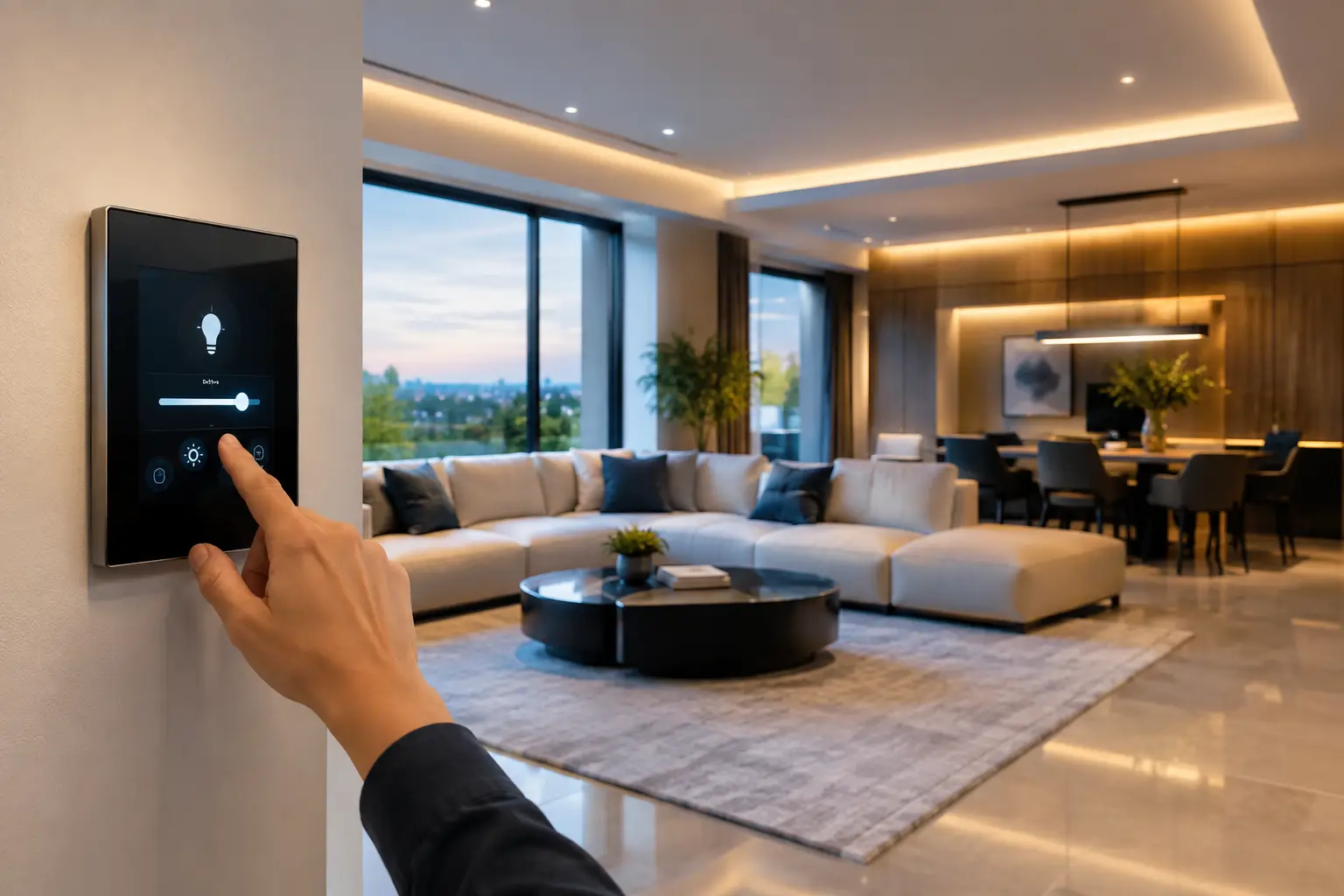
A beautifully detailed interior can quickly lose its impact when lighting is controlled by a row of mismatched switches, unreliable wireless devices and several competing apps. This KNX lighting review considers whether a professionally designed KNX system provides the better long-term answer for premium homes, offices and mixed-use developments.
KNX is not a decorative feature added at the end of a project. It is a building-control standard that can bring lighting, shading, heating, cooling, security and other services into one coordinated system. For clients who want technology to disappear into the architecture while remaining straightforward to use, that distinction matters.
What KNX lighting does differently
At its core, KNX enables switches, sensors, keypads, actuators and control processors to communicate over a dedicated control network. Rather than each circuit operating as an isolated function, the lighting scheme becomes part of the wider building environment.
A single wall keypad might set an evening scene that dims the main living space, brings feature joinery lighting to a considered level, lowers blinds and adjusts the temperature. In an office, the same principle can respond to occupancy, daylight levels and working hours, while maintaining manual control where it is useful.
This is why KNX is often specified on projects where the electrical installation needs to support a high level of control without making the finished space feel technical. The user sees an elegant keypad, a discreet sensor or a simple touchpanel. Behind it is a structured system designed around how the building will actually be used.
KNX lighting review: the principal strengths
The first strength is flexibility. A conventional switched circuit fixes much of the lighting behaviour at installation. KNX allows buttons, scenes and automated responses to be configured around the client’s routines. A bedroom keypad can provide a practical route to the bathroom at night, while a whole-house off command can switch off selected lighting when leaving the property.
The second is integration. Lighting is more effective when it is informed by the rest of the building. External lighting can work with access control and CCTV activity. Solar shading can react alongside lighting to manage glare. A presentation room can combine AV, lighting and blinds into a single, repeatable setting. This is particularly valuable in larger residences and commercial spaces, where separate systems otherwise create unnecessary friction.
Reliability is another compelling reason to consider KNX. The wired bus is designed for permanent building installations and does not depend on the changing quality of a domestic Wi-Fi network. Individual components communicate directly on the system, so the control architecture does not have to rely on one app or one consumer hub to make basic functions work.
There is also an aesthetic benefit. A well-planned KNX installation can reduce visual clutter by consolidating controls. That does not mean every function should be hidden behind a screen. The best schemes retain tactile, familiar controls at the point of use, then reserve touchpanels and mobile control for broader adjustments. Good control design makes the common actions immediate and the more detailed options available without being intrusive.
Where KNX needs careful consideration
KNX is not automatically the right choice for every property. It is usually most cost-effective when considered early, during a new build or substantial refurbishment, while cable routes, distribution boards, lighting circuits and control positions can be planned together.
Retrofitting KNX into a finished home is possible, but it requires a realistic assessment of access, wiring routes and the level of disruption a client is prepared to accept. Wireless elements may have a place in selected circumstances, yet they should not be used to disguise an underdeveloped infrastructure plan.
Initial cost is also higher than a basic switching arrangement. The value lies in the quality of the specification, installation, programming and future adaptability, rather than in a single piece of hardware. For a compact flat with a modest number of circuits, a simpler solution may be entirely appropriate. For a substantial house with layered lighting, motorised blinds, climate zones and security requirements, the cost can be justified by reduced complexity and a more coherent result.
KNX also depends on competent project coordination. The lighting designer, interior designer, electrical contractor, AV integrator and mechanical team need to agree on responsibilities early. If decorative fittings, dimming requirements and joinery details are selected late, the system may be forced into compromises that could have been avoided.
The technical decisions that shape the experience
A successful KNX lighting scheme begins with the lighting design, not the keypad. The project team should first establish the purpose of each space, the fittings being used, the required dimming performance and the desired scenes. Only then should the controls be mapped.
Choosing the right dimming approach
Not every LED fitting behaves in the same way. Phase dimming can be suitable for certain fittings and smaller applications, but it needs careful compatibility testing. DALI is often chosen for larger or more sophisticated lighting schemes because it offers addressable control, feedback and flexible grouping. KNX and DALI can work together effectively, with KNX managing the wider logic and DALI providing detailed luminaire control.
The correct choice depends on the fittings, driver locations, number of circuits and operational ambitions. It should never be based solely on what is easiest to procure. Poor dimming performance, flicker or an inconsistent low-end level will be noticed far more than the sophistication of the control system.
Designing scenes for real life
A scene should solve a recognisable need. “Cooking” might provide strong task lighting to worktops while keeping the dining area softer. “Dinner” may preserve the architectural character of the room without leaving guests in darkness. “Away” can turn off internal circuits, retain selected security lighting and prepare the property for an unoccupied period.
Too many scenes can make a system harder to understand. The aim is not to offer every conceivable option, but to create a small number of settings that feel immediately useful. For most clients, a clear keypad layout and dependable defaults are more valuable than endless personalisation.
Planning for maintenance and change
A KNX installation should be documented properly, with clear labelling, circuit schedules and records of programming. This protects the client long after practical completion, particularly when decorative fittings are replaced, a room changes function or a future extension is planned.
One of KNX’s advantages is that many changes can be made through reprogramming rather than major rewiring. There are limits, however. If a new fitting requires a different dimming method or additional electrical capacity, physical work may still be needed. Good future-proofing is not a promise that nothing will change. It is the disciplined provision of capacity, access and documentation so that change remains manageable.
Is KNX right for a residential project?
For a high-specification London townhouse, country home or major renovation, KNX is particularly well suited where lighting forms part of a broader technology brief. It can provide the calm, consistent control expected across reception rooms, bedrooms, bathrooms, exterior areas and ancillary spaces, while coordinating with shading, climate and security.
It is also useful for homes with several household members or staff. Intuitive controls reduce the need for informal instructions and make everyday operation less dependent on one person understanding a collection of apps. The building should work equally well for a family member, guest or housekeeper.
The strongest residential outcome comes from matching the system to the architecture. A minimalist interior may call for discreet engraved keypads and concealed sensors. A period property may need controls that respect original details while quietly providing modern performance. Technology should support the interior scheme, not compete with it.
How KNX performs in commercial spaces
In offices and commercial developments, KNX can help bring consistency to spaces with different occupancy patterns and operational demands. Meeting rooms, reception areas, circulation spaces and executive offices can each have appropriate lighting behaviour while remaining manageable from a central strategy.
Energy-conscious control is a practical benefit. Occupancy and daylight sensing can reduce unnecessary use, while timed functions and scene control help establish predictable operation across a building. Yet automation should be calibrated thoughtfully. Lights that switch off too quickly or sensors that respond poorly undermine confidence and encourage users to bypass the system.
For multi-storey schemes, KNX can also provide a dependable control layer alongside BMS, AV and network infrastructure. The exact integration approach should reflect the operational team, tenancy arrangement and maintenance model. A landlord-controlled common area has different needs from a tenant’s boardroom suite.
The verdict on KNX lighting
KNX is not simply a premium alternative to a smart bulb or a lighting app. It is a considered infrastructure choice for properties where lighting must perform beautifully, integrate with other services and remain serviceable over many years.
Its real value appears when the design is specific: the right fittings, the right dimming method, a control layout that feels natural and a coordinated installation process. For ambitious residential and commercial projects, that level of planning turns lighting from a collection of circuits into an integral part of how the building feels to live and work in.
The best next step is to review the lighting and technology brief together before first fix. When control, electrical design and interior intent are aligned early, the finished environment can remain both sophisticated and remarkably simple to use.








Keep In Touch