
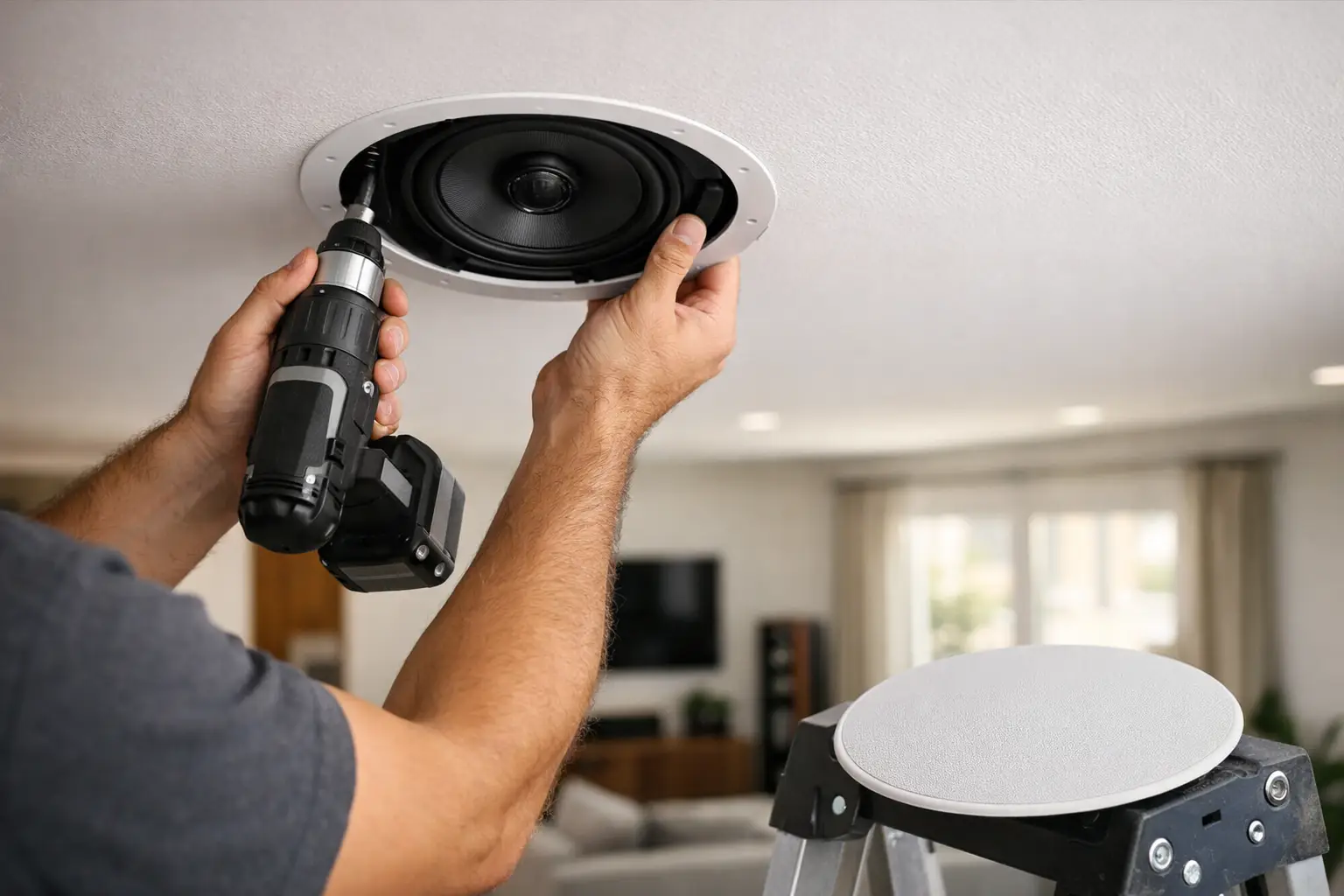
A ceiling can be the most valuable unused surface in a home. It can carry music through a kitchen without taking space from joinery, bring clear television sound to a family room without a visible soundbar, or create a calm, even audio backdrop across an entire floor. Done poorly, however, it can leave a beautiful interior with thin sound, visible grilles in the wrong places and difficult access for future service. A considered in ceiling speaker installation is therefore as much about the architecture as the audio.
For premium new-build and renovation projects, the best result is rarely achieved by choosing speakers in isolation. It comes from coordinating speaker positions, ceiling construction, lighting, cabling, network infrastructure and control before finishes are fixed. The goal is simple: excellent sound when wanted, and a discreet, intuitive system when it is not.
Start with how each room will be used
The first question is not which speaker to buy. It is what the room needs to do. A kitchen and dining area may need lively, even background music while people move between zones. A bathroom may benefit from a single stereo speaker or a carefully paired set at a lower volume. A cinema room or television lounge has different requirements again, where dialogue clarity, screen position and bass management matter more than whole-room coverage.
Open-plan spaces deserve particular attention. One large kitchen, dining and living area can look like a single zone on a floor plan, yet it may be used by different people at different times. Separating it into sensible audio zones gives greater control without making the system complicated. Music can play in the kitchen while the adjoining sitting area remains quiet, or the same source can follow guests across both spaces during entertaining.
Speaker count depends on room dimensions, ceiling height, furnishings and the desired listening level. More speakers do not automatically mean better sound. Too few can create obvious loud and quiet areas; too many can make a room feel over-driven and add unnecessary visual repetition. A tailored design establishes even coverage at comfortable volume rather than relying on one loud point source.
Plan in ceiling speaker installation before first fix
The most effective time to design an in ceiling speaker installation is before plastering and decorating. At first fix, cable routes can be protected, ceiling voids inspected and speaker locations coordinated with all other services. Retrofitting is possible, but it is more constrained and can introduce avoidable disruption to finished ceilings.
On a well-managed project, the AV design should sit alongside the reflected ceiling plan rather than being treated as an afterthought. Downlights, pendants, air-conditioning grilles, smoke detectors, access hatches, sprinkler heads and curtain pockets all compete for the same surface. A speaker positioned solely from a sketch can end up too close to a downlight or blocked by a structural beam.
Early coordination also protects the interior designer’s intent. In a formal reception room, grilles may need to align with lighting geometry or sit discreetly outside a ceiling feature. In a minimalist kitchen, they may need to avoid a carefully composed run of downlights. Small shifts in position can make a substantial difference to both appearance and audio performance.
Check the ceiling construction
A ceiling is not simply an empty void. It may contain timber joists, steelwork, services, insulation, acoustic treatments or a concrete slab. Each condition affects the speaker specification and installation method.
In period properties across central London, ceiling voids can be irregular, shallow or difficult to access. In contemporary flats, concrete construction may call for a different approach altogether, perhaps using a dropped ceiling detail or alternative speaker locations. The right solution depends on what the building allows, not on forcing a standard layout into an unsuitable structure.
Fire performance must also be considered. Cutting into a fire-rated ceiling can compromise its rating unless the correct speaker back box, fire hood or tested assembly is used. This is a technical and regulatory issue, but it has a practical benefit: the system is installed with the same care as the rest of the building fabric.
Allow for acoustic control, not only placement
An open-back ceiling speaker uses the void above it as part of its acoustic environment. That can produce inconsistent results if one speaker sits beside insulation and another opens into a larger cavity. Purpose-designed back boxes can improve consistency, reduce sound transfer to rooms above and help control unwanted vibration.
This is especially worthwhile in bedrooms below occupied rooms, flats, study spaces and homes where privacy matters. It can also be useful where music is intended to remain within one zone rather than travelling through floors and partitions. There is a trade-off: properly enclosed speakers require more ceiling depth and budget. Yet in the right locations, they provide a more controlled and refined outcome.
Choose speakers for the room, not the brochure
Ceiling speakers vary in driver size, dispersion, power handling and voicing. Larger models can provide more low-frequency weight, but they are not always necessary. A compact speaker may be the better choice for a small dressing room or hallway, while a larger, higher-output model can suit a generous kitchen, gym or open-plan entertaining space.
For rooms where people spend time seated, such as a dining room or lounge, speaker position should reflect the principal listening areas. For circulation spaces, the priority is even coverage as people move through them. In bathrooms, moisture resistance and sensible positioning away from direct water exposure are fundamental.
Where stereo imaging is important, such as a study or intimate sitting room, the left and right channels need appropriate separation. In smaller rooms, stereo single-point speakers can be useful because both channels are produced from one grille. They are a practical solution, not a universal replacement for a correctly positioned stereo pair.
Speaker grilles should be selected with the ceiling finish in mind. Many can be painted to match, but paint must be applied carefully. Heavy coats can obstruct the perforations and affect the sound. Frameless or low-profile grilles offer an especially discreet appearance, though the ceiling surface and installation tolerance must be of a high standard for them to look their best.
Do not overlook amplification and the network
The speaker is only one part of the audio system. Cabling, amplification, source equipment and network reliability have a direct bearing on the experience. Quality speaker cable should be routed away from sources of electrical interference where possible, clearly labelled and left with sensible service allowance. It is considerably easier to make good decisions at first fix than to trace an unlabelled cable after handover.
Centralised amplification can keep equipment out of living areas and make multi-room audio easier to manage. It does require well-planned ventilation, power provision and rack space. In some projects, local amplification may be more practical, particularly where the distance to a central equipment location is significant. The correct architecture should be decided around the building, the number of zones and the client’s expectations for future expansion.
A dependable network matters just as much when streaming services are a principal music source. Wi-Fi coverage, wired connections for key equipment and sensible network segregation all contribute to reliable playback. When the system is integrated properly, clients should not have to think about amplifiers, inputs or network settings. They should simply choose music from a familiar interface, a wall keypad or a single home-control app.
Integrate audio with the rest of the home
The value of concealed audio rises when it works naturally with lighting, shading and entertainment systems. A morning scene might bring gentle music into the kitchen and bathroom alongside the preferred lighting level. An entertaining scene can play the same playlist across selected rooms and terrace areas while leaving bedrooms undisturbed. At night, a single command can stop music across the property without searching for multiple apps.
This does not mean every room needs complex automation. Some clients prefer straightforward local controls with a limited number of favourites, while others want the convenience of full integration. Both can be elegant when the controls reflect the people who will use them.
For television rooms, ceiling speakers can complement the wider AV design, but they are not automatically the ideal front-channel solution. Screen-based viewing often benefits from speakers positioned closer to the display, where dialogue appears to come from the people on screen. Ceiling speakers may be excellent for surround, height channels or general music, while a discreet architectural soundbar or in-wall solution handles the front soundstage. The best approach depends on how seriously the room will be used for film and television.
Make future service part of the design
A finished ceiling should look effortless, but the system behind it should remain serviceable. Equipment should be accessible, amplifiers should have adequate ventilation and the final documentation should identify zones, cable routes and installed products. Where access panels are necessary, they can often be incorporated discreetly into joinery or ceiling details.
Commissioning is the final stage that turns installed equipment into a pleasurable system. Each zone should be checked for polarity, coverage, volume balance and control behaviour. This is also the point to set sensible maximum levels, particularly in bedrooms, children’s spaces or flat settings where neighbourly sound transfer is a consideration.
A carefully designed ceiling audio system should disappear into the home while making everyday moments better: breakfast in the kitchen, a quiet bath, a dinner with friends or music that follows the household without fuss. That combination of discretion, performance and simple control is what makes the planning worthwhile.








Keep In Touch