
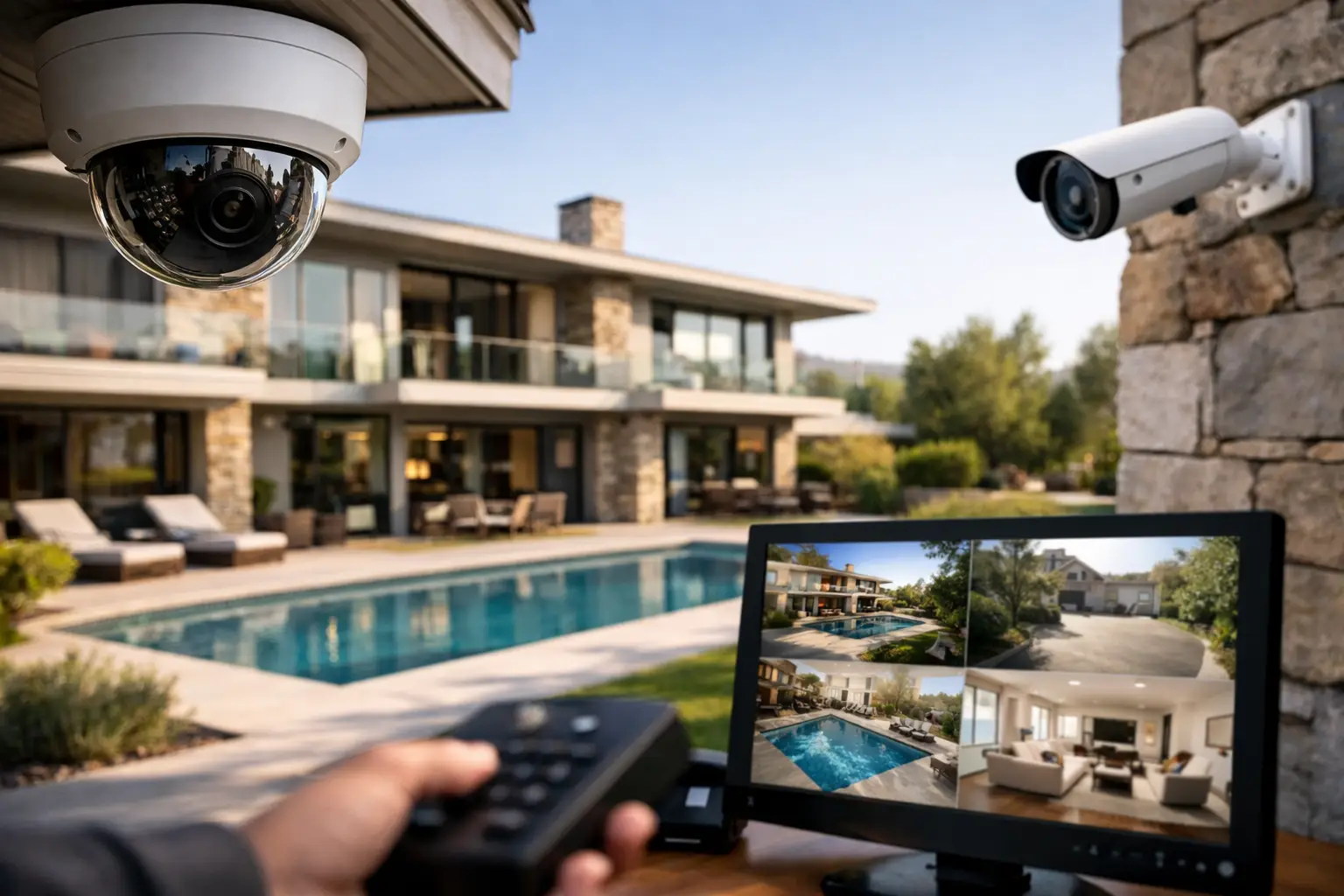
A large home rarely has one obvious point of entry. There may be a front gate, side passage, garden access, mews entrance, staff door, terrace, garage and several floors of living space. CCTV systems for large homes must make sense of that complexity without turning a carefully designed property into a collection of visible devices and separate apps.
The most effective approach is not to begin by counting cameras. It starts with how the property is used, who comes and goes, which approaches are exposed, and how security should work alongside lighting, access control and the wider home technology system.
Start with the property, not the camera catalogue
A substantial home needs a site-specific security plan. A detached house in Hampstead with landscaped grounds presents different risks from a Belgravia townhouse with a discreet rear entrance and multiple levels. The useful question is not simply, “Where can a camera go?” It is, “What needs to be understood if something happens?”
That means assessing the routes people take towards the house, the points at which they can enter, and the places where activity may be concealed. Gates, driveways, front doors, deliveries, basement access, garden boundaries and garages all deserve consideration. Internal coverage may also be appropriate around key circulation areas, wine stores, plant rooms or secondary entrances, but it should be specified with sensitivity to family life and privacy.
A well-designed system creates a clear chain of events. It should show a person approaching, arriving at an access point and moving through the relevant area, rather than capturing a collection of disconnected views. This is where professional design has real value: camera positions, lens selection, lighting conditions and recording requirements are considered together.
Why more cameras do not automatically mean better security
It is easy to over-specify CCTV. Too many poorly positioned cameras can produce an intimidating visual effect while leaving practical gaps in coverage. A camera mounted too high may show that somebody is present but fail to provide a useful facial image. One pointing into a bright exterior may struggle with contrast. Another may watch a wide garden but miss the gate used to enter it.
The objective is purposeful coverage. At entrances, the system should capture clear identification. Along boundaries and driveways, it should establish movement and direction. In areas where vehicles arrive or deliveries are made, it should provide a practical record without compromising the appearance of the façade.
Discreet camera choice matters as much as location. Some homes suit compact dome cameras set neatly into soffits; others need carefully finished external units positioned around architectural details. In heritage properties, especially across central London, preserving the character of stonework, joinery and listed features may be central to the brief. A considered installation works with the architecture rather than competing with it.
Night-time performance changes the specification
Security concerns do not stop when daylight fades. Gardens, side returns and driveways can become difficult environments for CCTV after dark, particularly where there are pools of light and deep shadow.
Infrared capability is useful, but it is not the whole answer. Camera placement must account for reflective surfaces, external lighting and the distance to the area being monitored. In many cases, sensitively designed automated lighting improves both security and the quality of recorded images. Pathway or façade lighting can be programmed to respond to activity, helping occupants see what is happening while supporting the camera view.
The balance is important. Excessive lighting can disturb neighbours, alter the character of a garden and make the home feel less comfortable. The right design uses light deliberately, only where it provides a genuine benefit.
The network is part of the security system
High-resolution cameras generate significant data, particularly on larger properties with multiple entrances and extensive grounds. The network system therefore needs to be planned as carefully as the cameras themselves.
A dependable wired connection is generally preferable for fixed cameras. It provides consistent performance, avoids reliance on household Wi-Fi and can supply power to compatible devices through the same cable. Wireless cameras may have a place in limited circumstances, but they are rarely the right foundation for a large, long-term installation.
Recording equipment should be located securely and sized for the number of cameras, image quality and desired retention period. There is no universal answer to how long footage should be retained. A family home with occasional visitors may have different needs from a property with regular contractors, domestic staff or a busy delivery schedule. Storage should be specified around the household’s practical requirements, not an arbitrary number.
Remote viewing also depends on sound network design and sensible cyber security. Owners should be able to check a gate, answer an alert or review an event when travelling, but access must be carefully protected. Secure credentials, managed remote access and properly maintained equipment are more valuable than convenience features that create avoidable exposure.
Integrating CCTV with access, lighting and control
CCTV is most useful when it forms part of a coordinated security experience. A camera at the gate, for example, can work with an intercom and access control system so that residents can see who has arrived, speak to them and grant entry from a single interface. This is particularly valuable in large homes where the front door may be several rooms or floors away.
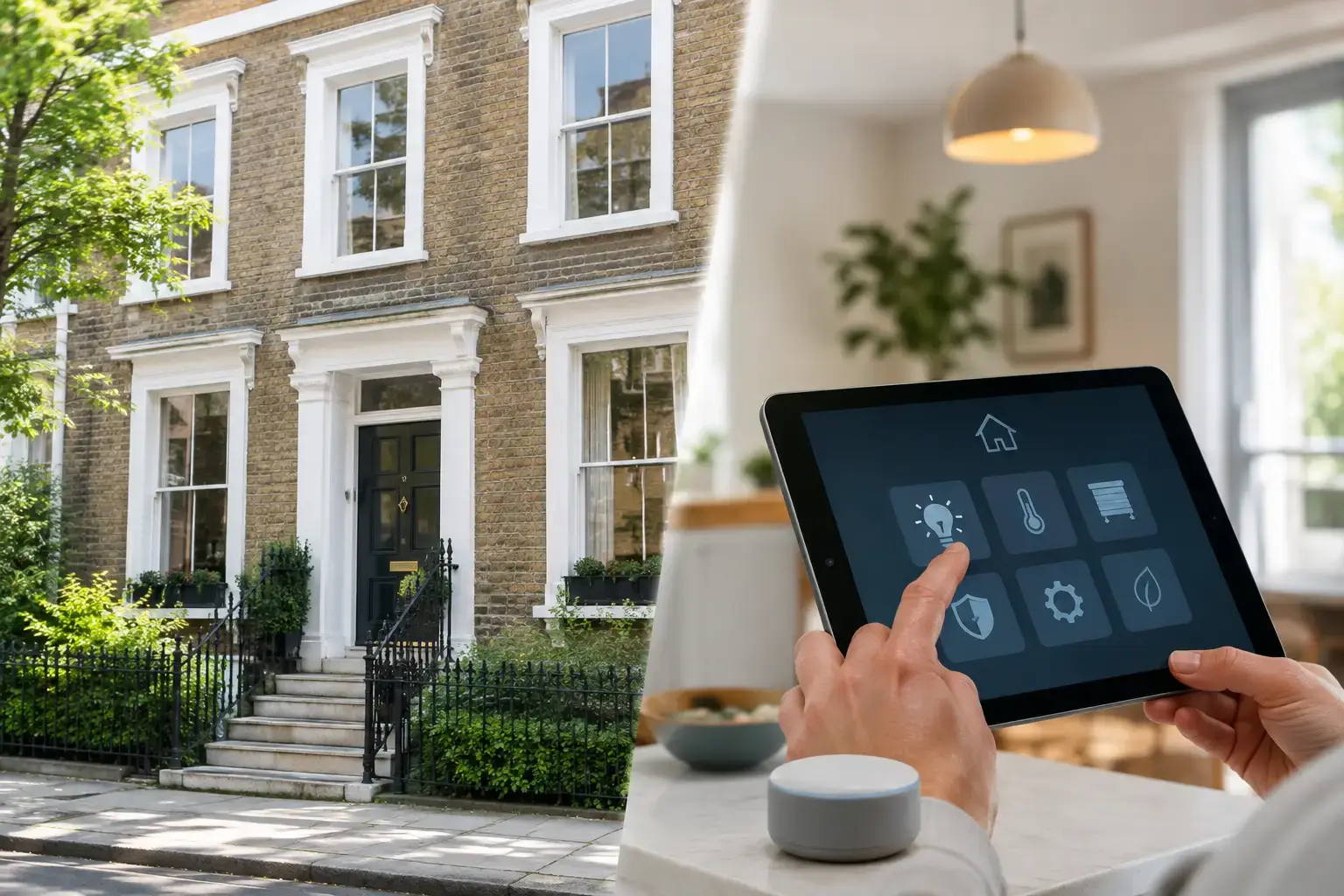
Integration can also reduce unnecessary friction. Rather than opening separate applications for cameras, gates and lighting, the household can view relevant camera feeds through a wall-mounted touch panel, a mobile device or a simple control interface. A dedicated security mode can check that gates are closed, activate selected cameras and adjust exterior lighting when the property is unoccupied.
The system should not become overly complicated simply because integration is possible. Not every camera needs to appear on every screen, and not every event needs to trigger an alert. A family should receive useful notifications, not a running commentary on normal activity in the garden.
Design alerts around real priorities
Intelligent detection can distinguish between people, vehicles and general movement, reducing the false alerts that often make homeowners ignore notifications altogether. The best settings reflect the daily rhythm of the house.
For instance, a driveway alert may be helpful overnight but unnecessary during the school run. A side-gate notification might be relevant when the home is empty, while a garden camera should not repeatedly alert residents because a pet or tree branch has moved. Fine-tuning takes thought, and it is one reason ongoing support matters after installation.
Privacy, staff and family life
A considered CCTV design protects the household without creating a sense of constant observation. Cameras should not be directed towards neighbouring properties, and internal coverage should be discussed openly with everyone affected by it. Bedrooms, bathrooms and private changing areas are clearly inappropriate locations.
Where staff work in the home, clear communication is sensible. Security cameras may be appropriate at entrances, service areas or valuable storage locations, but expectations should be transparent. A professional integrator can help establish an approach that supports security while respecting the people who live and work in the property.
Footage should also be treated as sensitive information. Restricting access to nominated users, keeping recording equipment secure and establishing sensible retention settings all help maintain control. For homes with staff, contractors or regular guests, these details are not administrative extras. They are part of responsible system design.
Plan CCTV early in a new build or renovation
The best time to design CCTV is alongside the electrical, lighting, landscaping and network plans. Early coordination allows cables to be concealed, camera locations to be incorporated into elevations, and equipment space to be allocated properly. It also avoids late changes that can compromise interior finishes or result in visible trunking around an otherwise refined home.
This is especially relevant in premium refurbishments, where the security system must respect architectural intent. Working with the architect, interior designer and contractor early gives every discipline the opportunity to resolve practical details before walls are closed and external finishes are complete.
For an occupied home, installation is still possible, but the options may be more constrained. A survey should identify the least disruptive cable routes and make clear where compromises may be necessary. Honest advice is better than promising invisible results where the building fabric does not allow them.
Choose a system that can be supported
CCTV equipment is not a fit-and-forget purchase. Camera views can be obscured as planting matures, settings may need adjustment as a family’s routine changes, and network or software updates require competent management. A system that is technically impressive on handover day is only useful if it remains straightforward and dependable years later.
MOSAIC approaches security as part of the wider intelligent home, bringing CCTV, access control, networking and automated lighting into one considered design. The aim is not to put more technology in view. It is to give residents a clearer sense of what is happening around their home, with controls that remain calm and easy to use.
A well-planned CCTV system should fade into the background of daily life. It is there when a delivery arrives, when the house is empty, or when something needs checking, while allowing the property to remain exactly what it should be: a comfortable, private home.




Keep In Touch